Inheriting the Machine Room: What Fast-Growing Companies Leave Behind in Their Infrastructure
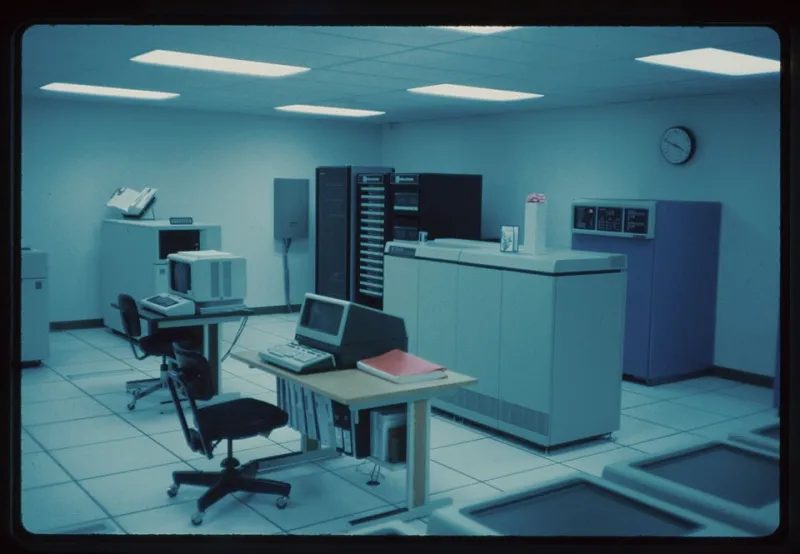
Photo: Columbus Metropolitan Library, No restrictions, via Wikimedia Commons
Every fast-growing company eventually outgrows the infrastructure it built in its first eighteen months. The founders move on, the engineers who wrote the Terraform take new jobs in Austin or Seattle, and the architecture they left behind — duct-taped, over-provisioned, half-documented — becomes someone else's problem.
That someone else is usually a new hire, an acquired team, or a managed hosting partner brought in to stabilize things. And according to the engineers who've done this inheriting, the mess follows predictable patterns.
The Over-Provisioned Staging Environment
The most common artifact of growth-stage panic is a staging environment that costs more than production did a year earlier. "They cloned production in a hurry before a big launch, sized everything for the worst case, and never turned it off," one platform engineer in Denver told us. "Four years later, that staging stack is running three databases nobody has logged into since the Obama administration."
The lesson for anyone evaluating inherited infrastructure: audit environment parity first. Staging that mirrors production at full scale is a comfort, not a requirement. Right-sizing non-production environments routinely cuts 30 to 40 percent from a cloud invoice, and it forces a conversation about what production actually needs.
The Undocumented Cron Job Nobody Dares to Touch
Ask any engineer who's onboarded onto a legacy stack about cron jobs and watch them wince. There is always one — scheduled at 3:47 a.m. Pacific, writing to a table nobody recognizes, owned by an employee who left in 2019. "We ran it in isolation for a month before we figured out it was the only thing keeping a legacy billing reconciliation alive," said a consultant who works with mid-market companies in the Midwest.
The survival guide here is methodical observation, not aggressive cleanup. Snapshot the job, log its outputs, trace its dependencies, and only then decide whether it earns its place. Teams that delete first and ask questions second tend to meet their customers' accounting departments very quickly.
Architecture as an Archaeological Record
What makes inherited infrastructure genuinely instructive is that it records the company's history layer by layer. The single-region deployment reflects the era when all customers were domestic. The hand-rolled failover script marks the quarter the primary host went down during a product launch. The sudden appearance of a CDN in front of everything marks the month a viral moment melted the origin servers.
Reading these layers correctly is a skill, and it's one worth developing even if you never inherit anyone's servers — because someday, someone will inherit yours. Every shortcut you take today is documentation debt for the next team.
Turning Inheritance into Due Diligence
For acquirers and new technical leadership, the inherited stack is a diagnostic tool. An over-provisioned, undocumented environment doesn't just signal waste; it signals how the organization made decisions under pressure. A clean, boring, well-documented setup suggests an engineering culture that valued sustainability over heroics.
If you're evaluating an inherited platform, start with three questions: What is running that nobody can explain? What would break if the one person who understands it left? And what does the cost curve look like if traffic doubles? The answers reveal more about the business than any pitch deck.
Building So the Next Team Doesn't Suffer
The engineers we spoke with agreed on one closing principle: write your infrastructure for the person who arrives after you. Document the cron jobs. Right-size the staging. Label the failover scripts. Cloud platforms make it easy to provision in minutes and hard to remember why, months later, anything exists at all.
Growth is the goal. But the measure of a well-run infrastructure isn't how fast it scaled — it's how gracefully the next team can pick it up and keep going.